Manage, Optimize and Enhance Cloud Efficiency
Increasing cloud adoption across industries is offering a due boost to the Cloud Service Providers (CSPs).
Reliance on CSPs is majorly being driven by organizations’ inability to manage all cloud-related tasks in-house.
This has eventually given rise to the ‘Cloud Managed Services’ trend in the US.
The ‘Cloud Managed Services’ offer you a comprehensive cloud management support by handing over the complete responsibility of your cloud operations to Cloud Managed Service Providers (MSPs).
End-to-End Managed Cloud Services

Cloud Deployment

Cloud Security

Network and Storage

Cloud Monitoring and Reporting

Backup and Disaster Recovery

Infrastructure Set Up

Business Continuity

Cloud Migration Services
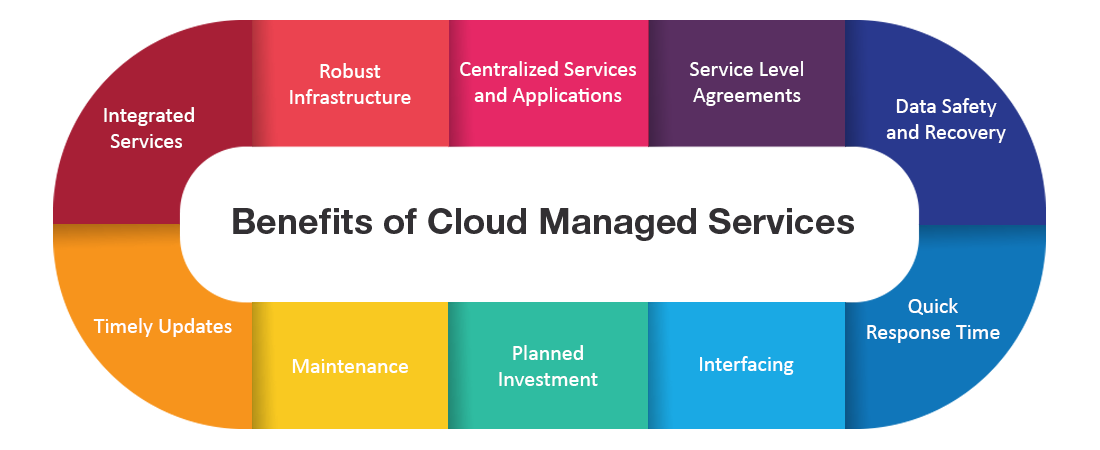
Benefits of Cloud Managed Services
Often considered less expensive than in-house management, Cloud Managed Services provide a wide a range of business benefits, such as:
Why Cloud Managed Services?
Effective management continues to be the key priority for most organizations, as cloud adoption continues to rise in the US.
To address this challenge, the American-based organizations choose different ways to manage their cloud infrastructure. Some manage it themselves, and some bring in a Cloud MSP to ease their immediate complexities, while some choose to have a managed cloud service provider who can handle broader mission with a clear vision on managing hybrid environments and resources.
A perfect cloud managed service provider can address the above, and many such concerns required for effective cloud infrastructure management.
Services provided with the standard database support package include:
Initial database software installation, including configuration and verification as required.
Performance of daily or weekly backups to disk, as requested by customer.
Management and monitoring of disk space.
Database restoration, as needed.
Rebuilding of database indexes, as required.
A primary on-call DBA to respond to alerts and customer issues as defined by the level of customer support.
Other service options available, depending on database software, include but are not limited to:
Standby databases to support business continuity.
Replication.
Database cloning for development environments.
Data conversion/migration assistance.
Database query tuning.
Database upgrades/patching.
Database security maintenance.